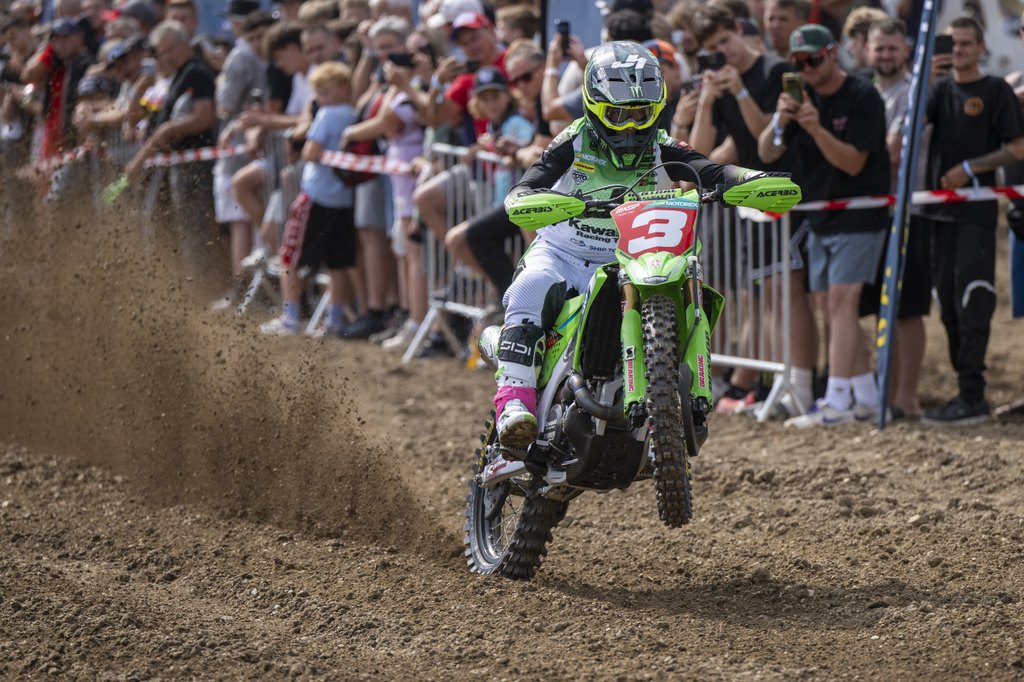
Long before Kawasaki became one of the most recognizable names in motocross, Kawasaki Heavy Industries was building ships, trains and aircrafts. That background gave the company engineering depth, but it did not give it motocross credibility. That had to be earned the hard way — in mud, sand, ruts, long motos, stadium whoops and Grand Prix pressure.
Over six decades, Kawasaki would become one of the sport’s defining manufacturers. Its machines carried riders to AMA and FIM championships. Its Uni-Trak suspension helped move motocross into the single-shock era. Its Team Green programme changed amateur racing in America. Its relationship with Mitch Payton’s Pro Circuit created one of the most successful 250-class programmes in the sport. And during the four-stroke revolution, Kawasaki even joined forces with Suzuki in one of motocross’s more unusual business partnerships.
But the story starts in Japan, with a motorcycle that looked nothing like the Green Machines we know today.
The Red Tank
In the early 1960s, Kawasaki was still finding its way as a motorcycle manufacturer. The company had manufacturing muscle, and its relationship with Meguro helped strengthen its motorcycle business, but racing credibility was still missing.
That changed with the B8M.
Kawasaki engineers took the practical B8 125cc street bike and turned it into a motocross machine. They stripped off road equipment, fitted off-road tyres, upgraded the suspension, raised the exhaust, added motocross-style controls and tuned the rotary-valve two-stroke engine for more power.
The result was the 1963 Kawasaki B8M.
With its red fuel tank, it became known as the “Red Tank.” It was not glamorous by modern standards, but it was purposeful. More importantly, it worked.
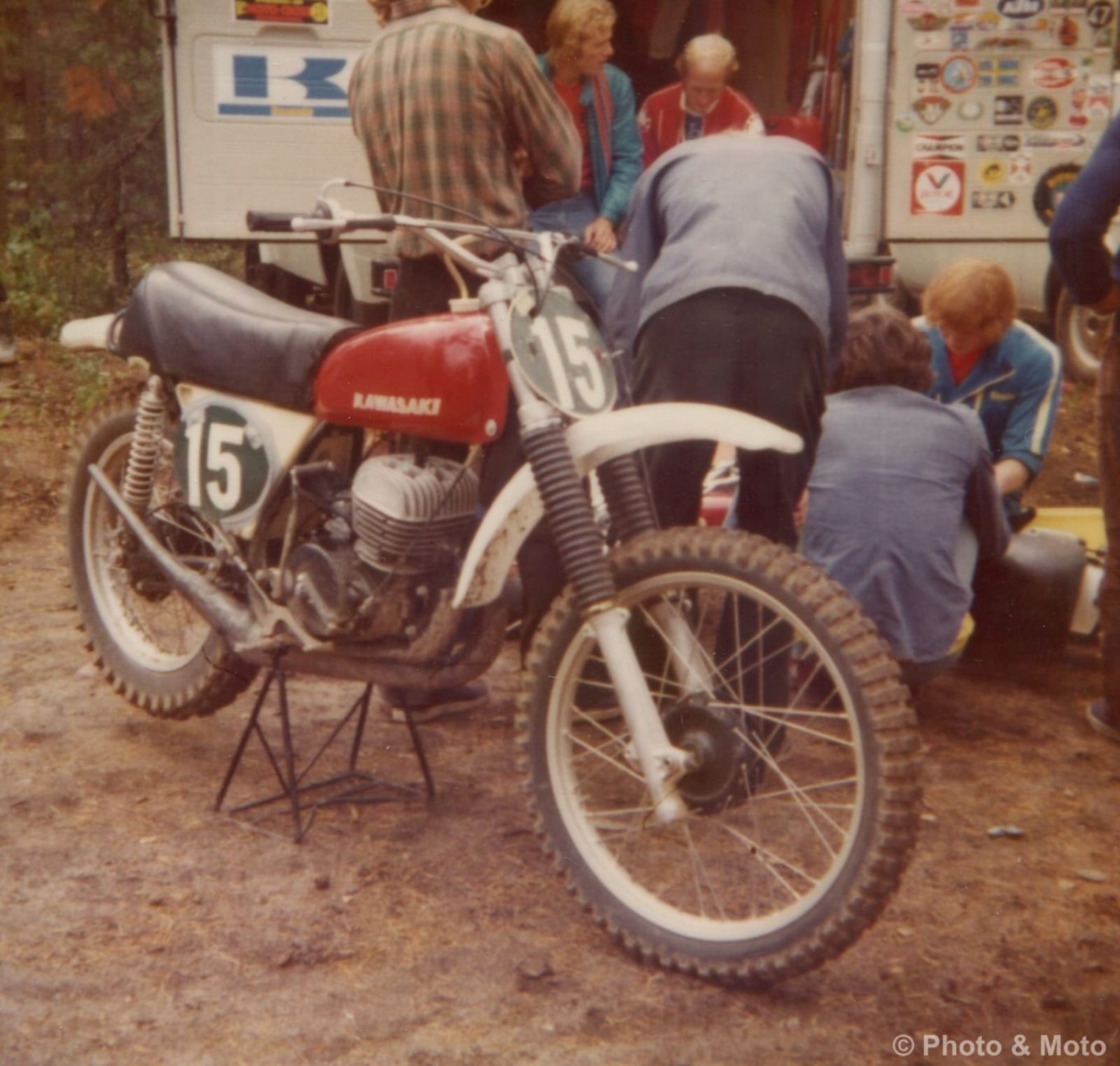
At the 1963 Hyogo Prefectural Motocross race at Aonogahara, Kawasaki riders swept the top six positions in the 125cc class. For Kawasaki, that result was bigger than a race win. It proved the company could build serious competition motorcycles. It helped justify further investment in the motorcycle division. And it showed that motocross could be more than a weekend experiment. It could become a development tool and a brand builder.
Without the Red Tank, the Green Machine story may have looked very different.
The birth of Lime Green
After proving itself at home, Kawasaki looked overseas. America was becoming a huge motorcycle market, and off-road riding was growing fast. Scrambles, desert racing and early motocross were pulling young riders into dealerships, and the Japanese manufacturers understood the obvious truth: winning sold motorcycles.
In 1967, Kawasaki introduced the F21M, a purpose-built scrambles racer powered by a 238cc rotary-valve two-stroke engine. It was a more serious competition machine than the modified street bikes that had come before it, and its 21-inch front wheel showed that Kawasaki was learning what riders needed off-road: stability, confidence and control, not just horsepower.
Then came the colour change.
Kawasaki moved away from the early red identity and adopted Lime Green. It was bright, bold and nearly impossible to miss on a racetrack. Against the more traditional colours of its rivals, Kawasaki stood out immediately.
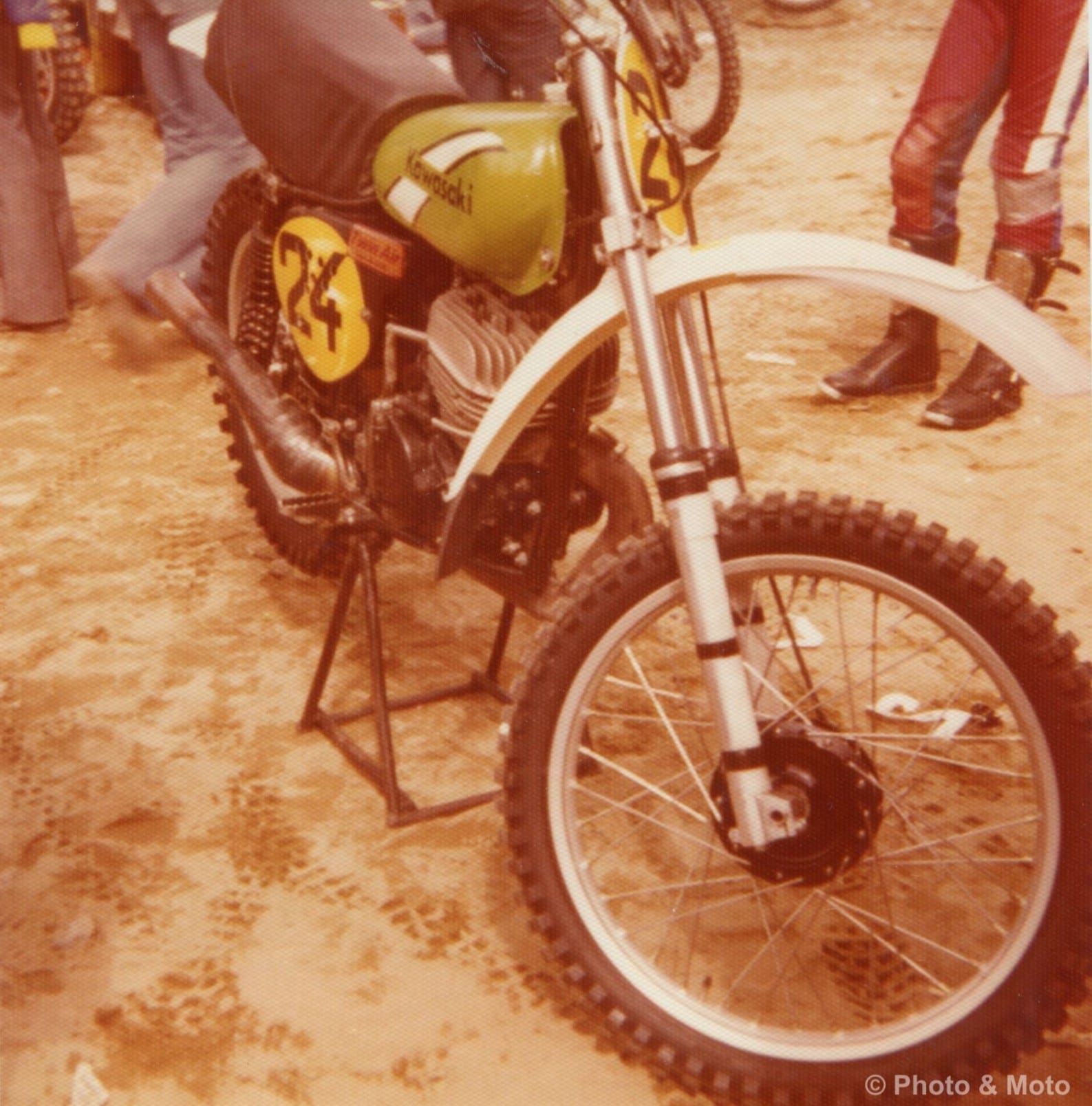
That mattered. In motocross, visibility is part of identity. More than half a century later, few motorcycle brands are as closely tied to one colour as Kawasaki is to Lime Green.
The Green Machine had arrived.
Two fronts: America and Europe
By the early 1970s, Kawasaki had a bigger ambition. It wanted to compete in both America and Europe.
Those were two very different challenges.
In the United States, motocross was exploding. The AMA National Motocross Championship was developing, supercross was beginning to take shape, and motorcycle sales made the American market impossible to ignore. Winning in America meant more than trophies. It meant showroom credibility.
Europe was different. The FIM Motocross World Championship was still the sport’s established proving ground. European manufacturers such as Husqvarna, CZ, Maico and Bultaco had years of experience on natural-terrain tracks. The circuits were rough, long and varied: Belgian sand, Scandinavian hardpack, Italian hillsides, French mud and Eastern European terrain that exposed weak engines and poor suspension quickly.
Kawasaki had to fight both battles at once. In America, it needed winners. In Europe, it first needed teachers.
Learning Europe: Pettersson, Hansen and Hammargren
Kawasaki quickly discovered that European motocross could not be conquered from an engineering office in Japan. The tracks were too different, the riders too experienced and the conditions too punishing. Kawasaki needed riders who could race at Grand Prix level and explain exactly what the motorcycles needed.
One of the first was Swedish rider Olle Pettersson.
Pettersson was valuable because he brought development knowledge as well as speed. He helped Kawasaki refine its early 250cc works machines for European conditions, giving feedback on handling, suspension, stability and power delivery. His sixth-place finish at the 1972 French Grand Prix gave Kawasaki its first FIM World Championship points. It was not a title, but it was a sign that Kawasaki had arrived in Grand Prix motocross.
Then came Torleif Hansen.
Hansen deserves more space in Kawasaki history because he helped move the company from development progress to genuine championship contention. He finished fourth in the 1973 FIM 250cc World Championship and later came even closer. In 1978, Hansen won the final two Grands Prix of the season and finished runner-up in the 250cc World Championship.
That result mattered. It proved Kawasaki was no longer just learning. It was threatening to win.
Christer Hammargren added another milestone. In 1975, he gave Kawasaki its first 500cc Grand Prix moto victory at the Italian Grand Prix. In the brutal open class, that was a serious statement.
Pettersson helped develop the bikes. Hansen proved Kawasaki could fight for a world title. Hammargren delivered a major premier-class GP race win. Together, they gave Kawasaki the European foundation it needed.
Winning America first
While Kawasaki was still learning Europe, it started winning in America.
In 1972, the AMA launched its first independent National Motocross Championship. Kawasaki signed Brad Lackey and put him on a factory 450cc works machine in the 500cc class. Lackey won five of the eight rounds and became the inaugural AMA 500cc National Motocross Champion.
That was a landmark result for Kawasaki. It gave the brand a major American motocross title at exactly the moment the sport was becoming nationally important.
After Lackey left to chase his dream of becoming world champion in Europe, Kawasaki turned to Jimmy Weinert.
Known as “The Jammer,” Weinert brought toughness, confidence and personality. He won the 1974 AMA 500cc National Championship for Kawasaki and became one of the defining American riders of the decade.
His importance went beyond national titles. Weinert’s win at Lake Whitney in the 1973 Trans-AMA series helped show that American riders were closing the gap to the Europeans. For years, the Europeans had been treated as motocross royalty. Weinert’s victory showed that the balance was beginning to shift.
He later added the 1976 AMA 250cc Supercross Championship, giving Kawasaki early credibility in stadium racing. Supercross was still young, but it would soon become the sport’s biggest American stage.
By the mid-1970s, Kawasaki had won in America, scored in Europe and established itself as more than a newcomer.
Then came the suspension revolution.
Uni-Trak changes the sport
The late 1970s were a turning point in motocross engineering. Engines were getting faster. Tracks were getting rougher. Riders were jumping farther. Traditional twin-shock rear suspension was reaching its limit.
Kawasaki’s answer was Uni-Trak.
The idea was simple to understand but difficult to perfect: replace twin rear shocks with a single shock connected through a linkage system. The benefit was rising-rate action. The suspension could feel controlled over smaller bumps but become progressively firmer as it compressed harder over big hits.
That gave riders more control in rough conditions and better resistance to bottoming on jumps and square edges.
Brad Lackey helped test the system in Grand Prix racing, giving Kawasaki feedback in the harshest conditions available. Grand Prix tracks did not forgive weak ideas, and Uni-Trak proved it had a future.
The significance went beyond Kawasaki. The sport was moving away from twin shocks, and rising-rate single-shock systems soon became the direction of modern motocross design.
Uni-Trak was one of Kawasaki’s defining technical contributions to the sport.
Team Green: The amateur revolution
If Uni-Trak changed motorcycles, Team Green changed rider development.
By the early 1980s, Kawasaki had professional success, but it needed deeper roots at American amateur races. The company realised that young riders and their families needed more than a motorcycle. They needed support, parts, advice and a reason to believe Kawasaki was invested in their progress.
In 1981, Kawasaki launched Team Green.
The idea was simple and brilliant: support riders before they became stars.
Team Green provided trackside help, technical advice, parts assistance and contingency incentives at amateur events. Kawasaki put people in the pits, where racing families were actually making decisions. That presence mattered. When a parent was trying to keep a bike running between motos, support could be just as persuasive as horsepower.
Under Dave Jordan and later Bruce Stjernstrom, Team Green became the model for amateur support programmes. It helped Kawasaki identify talent early, build loyalty and create a clearer path from amateur racing to the professional ranks.
The list of riders connected to the broader Kawasaki development story became remarkable: Jeff Emig, Jeremy McGrath, Ricky Carmichael, James Stewart, Ryan Villopoto and Eli Tomac, among others. Not every rider stayed green forever, but Team Green’s impact on American motocross was undeniable.
Kawasaki was no longer only building race bikes.
It was helping build racers.
Ward, the KX500 and Pro Circuit
Through the 1980s, the KX name became one of motocross’s strongest identities. The bikes were fast, aggressive and unmistakably green. No rider represented that era better than Jeff Ward.
Ward was one of the most versatile champions in American motocross and supercross. He won across classes and disciplines, giving Kawasaki the kind of long-term factory hero every brand wants: loyal, technical, tough and successful.
The KX500 added to Kawasaki’s reputation. Big-bore two-strokes were not polite motorcycles, and the KX500 became one of the most respected open-class machines of its era. It was brutally fast, demanding and highly effective in the right hands.
Then came another major piece of the Kawasaki system: Pro Circuit.
Mitch Payton’s Pro Circuit began as a tuning and performance business, but its relationship with Kawasaki turned it into one of the most successful 125/250 programmes in American motocross and supercross. The partnership worked because each side brought something valuable. Kawasaki had the bikes, factory backing and amateur pipeline. Pro Circuit had the tuning knowledge, race-team discipline and ability to sharpen young riders under pressure.
Team Green and Pro Circuit became two halves of the same development ladder. Team Green helped find and support young talent. Pro Circuit refined that talent in the professional 250 class. The factory 450 team then had a clearer path to future premier-class riders.
It was smart, structured and very Kawasaki.
Europe finally follows
For all its progress in the 1970s and 1980s, Kawasaki still had one major piece of unfinished business: an FIM Motocross World Championship.
It had earned points. It had won motos. It had challenged for titles. But the world championship itself had remained out of reach.
That changed in 1995.
Stefan Everts won the 250cc World Championship on Kawasaki, delivering the Grand Prix breakthrough the brand had chased for decades. It was the payoff for a European effort that had started with learning and development in the early 1970s.
The success continued with Sébastien Tortelli. The French teenager won the 125cc World Championship in 1996 on Kawasaki, then moved up and captured the 250cc World Championship in 1998 after a fierce battle with Everts. Tortelli gave Kawasaki not only titles, but excitement. He was young, fast and fearless.
Mickaël Maschio added another 125cc world title in 2002, and Christophe Pourcel won the MX2 World Championship in 2006 during the sport’s transition into the four-stroke era.
By then, Kawasaki had proven itself across the major stages of motocross: Japan, America, supercross, amateur racing and the FIM World Championship.
But motocross was about to change again.
The four-stroke gamble: Kawasaki and Suzuki
At the turn of the millennium, motocross faced its biggest technical shift since long-travel suspension.
Four-strokes were coming fast.
Yamaha had changed the market with the YZ400F and then the YZ250F. The rules favoured four-stroke development, customers were paying attention, and manufacturers that missed the shift risked falling behind.
For Kawasaki, developing a competitive lightweight 250 four-stroke was a major task. Suzuki faced the same problem. So two rivals made a rare and practical decision.
They worked together.
In 2001, Kawasaki and Suzuki announced a strategic alliance. The most famous product of that relationship was the jointly developed 250cc four-stroke motocross bike sold as the Kawasaki KX250F and Suzuki RM-Z250.
It was an unusual story: two Japanese competitors sharing development because the cost and urgency of the four-stroke transition were too high to ignore. Suzuki contributed heavily to the engine side, while Kawasaki handled much of the chassis, suspension and overall motorcycle package. The bikes were closely related mechanically, separated mainly by colour, branding and team identity.
For Kawasaki, the timing was critical. The KX250F gave the company a place on the starting gate during the sport’s most important technical transition in decades.
The bike found success in racing, especially through Pro Circuit Kawasaki. But the early production models also showed the risks of joint development. Riders and mechanics remember the first-generation KX250F/RM-Z250 as fast and agile, but also difficult at times, with reliability and starting concerns affecting its reputation.
The alliance served its purpose, but it was not built to last. By the mid-2000s, Kawasaki and Suzuki returned to independent development. Kawasaki’s later KX250F became its own machine, with an aluminum perimeter frame and a more mature four-stroke platform. Suzuki followed with its own independent RM-Z250.
The partnership was brief, but historically important. It helped Kawasaki bridge the four-stroke revolution without missing the wave.
The modern picture
In recent years, Kawasaki’s strongest headline has come from Europe.
Romain Febvre kept Kawasaki Racing Team in the MXGP title fight through several seasons of near misses, including runner-up finishes in 2021 and 2023. Injuries interrupted parts of the journey, but his speed kept Kawasaki at the front of Grand Prix motocross.
In 2025, Febvre delivered the major modern breakthrough: the MXGP World Championship for Kawasaki. That title returned the brand to the top of the premier class in world motocross and gave the modern KRT structure its defining achievement.
In America, the recent picture has been more mixed. Monster Energy Kawasaki has remained competitive in the AMA premier classes, especially during Jason Anderson’s strong 2022 season, but it has not recently dominated 450 Supercross or Pro Motocross the way Kawasaki did in earlier eras.
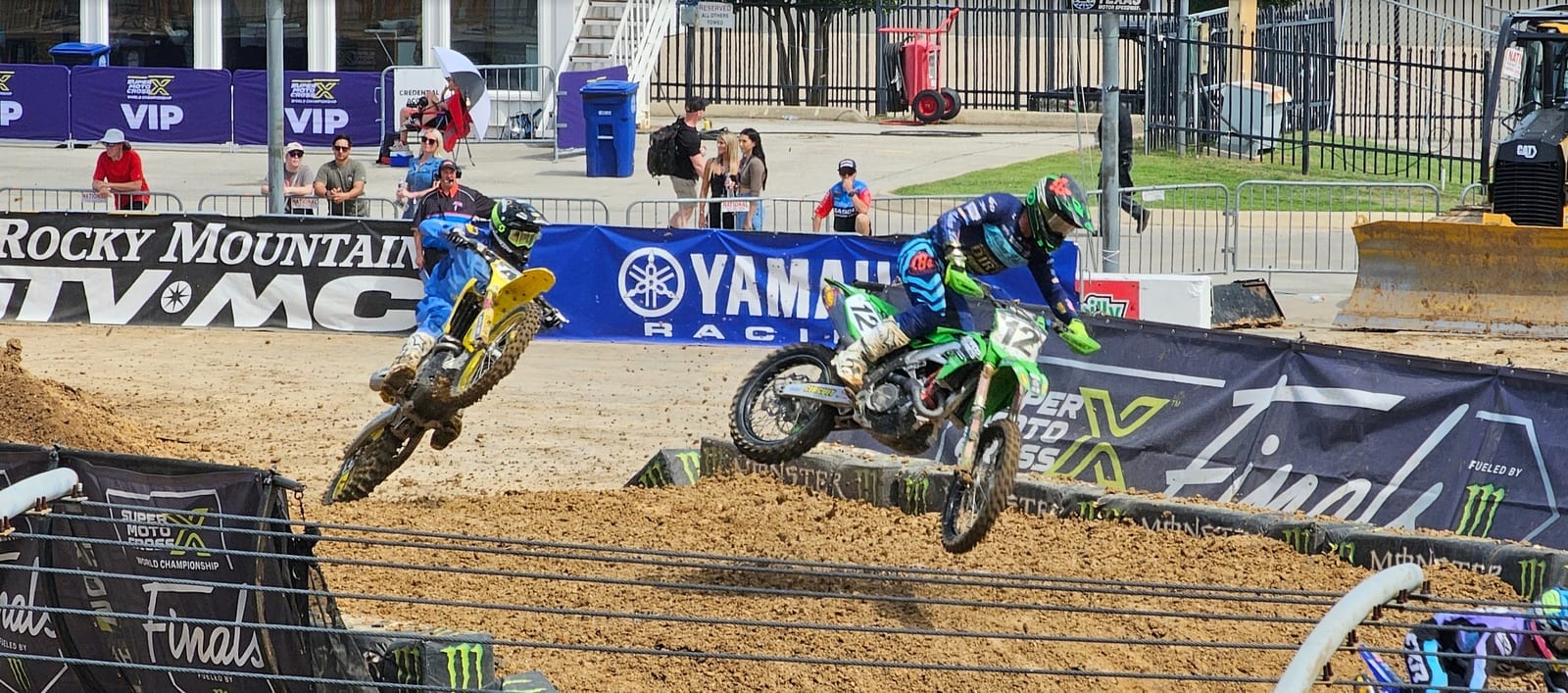
The Pro Circuit 250 programme remains a major part of the brand’s American identity, continuing to develop front-running riders and race-winning machinery. But the modern AMA landscape is brutally competitive, and Kawasaki is still chasing its next premier-class American crown.
That is the balanced view: Europe has delivered Kawasaki’s biggest recent championship success, while America remains competitive and dangerous.
Kawasaki today: three racing pillars
For 2026, Kawasaki’s global motocross structure is best understood through three major racing pillars.
In the United States, the premier-class effort is Monster Energy® Kawasaki, Kawasaki’s factory 450 team. Kawasaki describes the squad as one of the most decorated teams in American supercross and motocross, and credits the programme with 25 premier-class titles. For 2026, the team races the KX™450SR with Chase Sexton and Garrett Marchbanks, while Cornelius Tøndel has been listed as an outdoor factory fill-in rider as the team manages Sexton’s injury recovery.
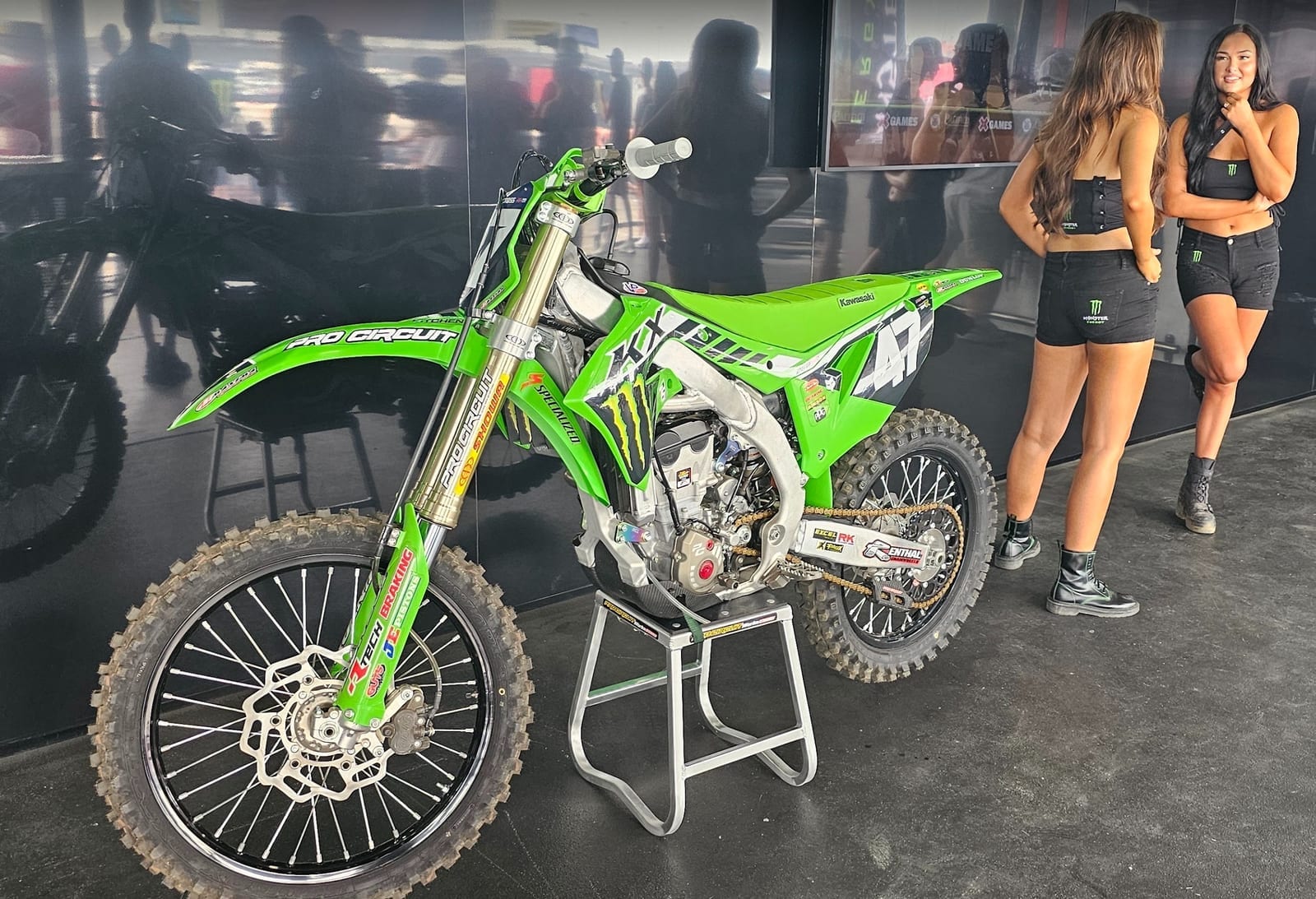
The American 250-class effort remains Monster Energy® Pro Circuit Kawasaki. Kawasaki credits the brand with 38 combined 250-class supercross and motocross championships, with Pro Circuit responsible for 31 of those titles. For 2026, Mitch Payton’s team fields Levi Kitchen, Drew Adams, Seth Hammaker and Cameron McAdoo on KX™250 machinery across the SMX schedule.
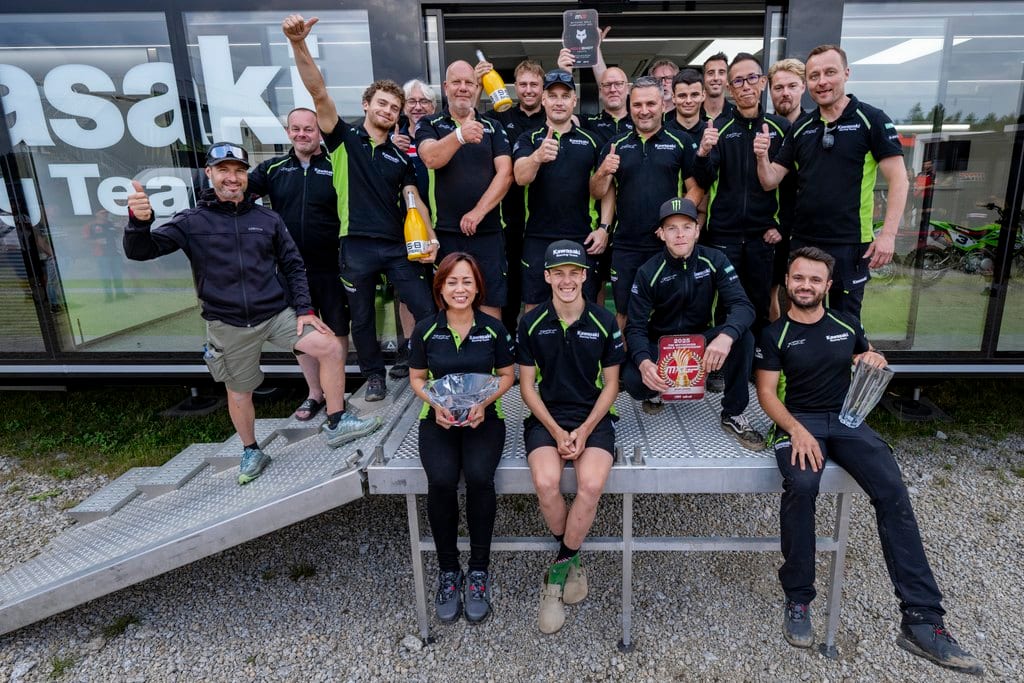
In Europe, Kawasaki Racing Team MXGP carries the brand’s Grand Prix programme. Managed by Antti Pyrhönen with Kimi Räikkönen as team principal, the team enters 2026 with Febvre carrying the number-one plate as reigning MXGP World Champion and Pauls Jonass alongside him on the factory KX™450SR. In MX2, Mathis Valin continues Kawasaki’s push aboard the KX™250.
The split says plenty about modern Kawasaki. In America, the brand races under production-based rules where showroom relevance matters. In Europe, the Grand Prix programme has more room for works-level development. Pro Circuit sits in the middle as the professional 250-class development engine that has fed Kawasaki’s American success for decades.
Different teams. Different rulebooks. Different continents. Same green objective.
The legacy
Kawasaki’s motocross story has never been about one rider, one bike or one championship. It is a story of learning and adapting.
The Red Tank proved Kawasaki could build a winning dirt bike. Lime Green gave the brand an identity. Lackey and Weinert made Kawasaki a winner in America, while Pettersson, Hansen and Hammargren helped it earn respect in Europe. Jeff Ward carried the KX name through one of Kawasaki’s strongest factory eras. Uni-Trak changed the bikes. Team Green changed the way young riders were supported. Pro Circuit turned the 250 class into one of Kawasaki’s strongest weapons.
The world titles won by Everts, Tortelli, Maschio and Pourcel proved that Kawasaki’s long European effort had paid off. The Suzuki alliance showed the company could be practical when the four-stroke era arrived. More recently, Romain Febvre and Kawasaki Racing Team MXGP brought the brand back to the top of world motocross.
That is Kawasaki’s real legacy: keep learning, keep racing and keep coming back stronger.
From the Red Tank to Team Green, the dirt has always been Kawasaki’s proving ground.
And the green machines are still built to win.